So as I described in the previous post, I’ve been working on blending regular interlinked and interlaced sprang. The first picture below shows the progress I made in chronological order, left to right, and then below that I’m going to discuss each pouch in greater detail. All five pouches were warped with 24 loops, alternating between two colours.
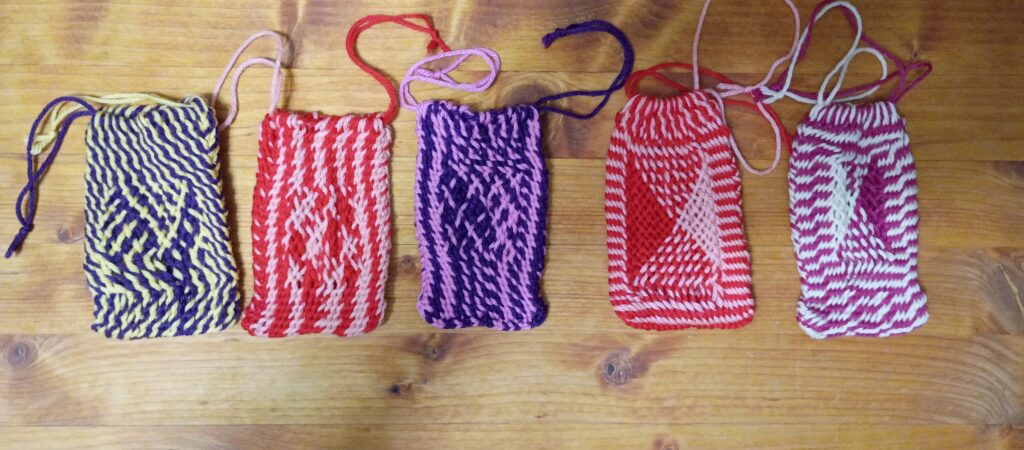
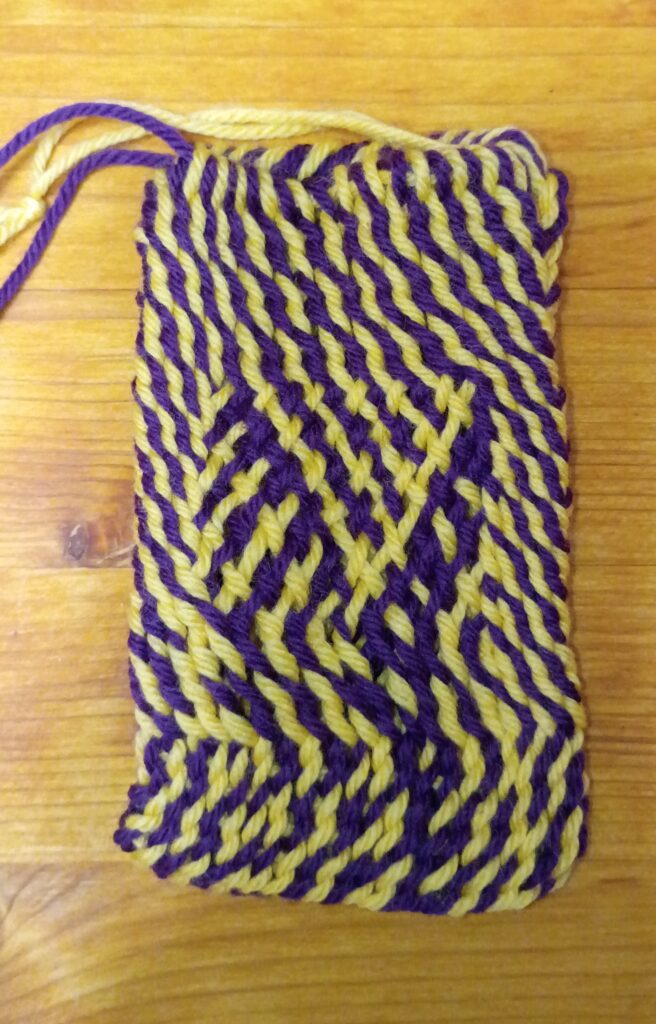
The first pouch where I tried to follow the pattern described in the previous post, where the interlinking started out as z-twist. After years of spranging in s-twist, this was more complicated than expected. The sprang is very loose, and for the bottom few rows I switched back to s-twist. Also, looked nothing like what I expected.
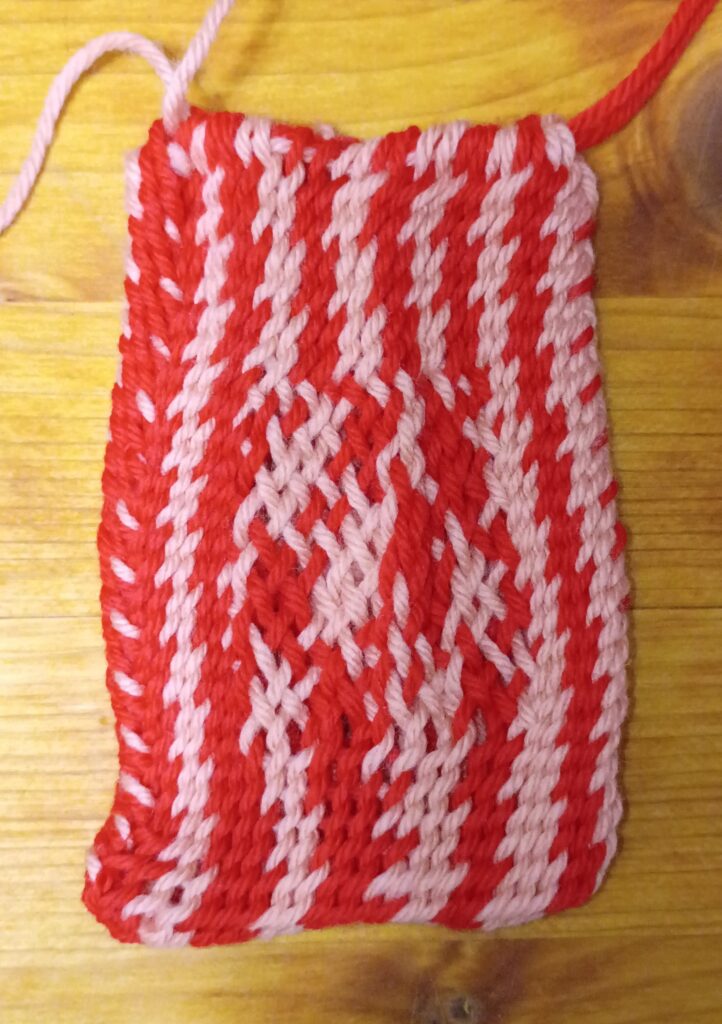
So I changed the startup position for the interlacing from AABB to AAAABBBB. This looked less busy, but there were still tension issues, and moreover, the diagonal stripes were 4 threads wide.
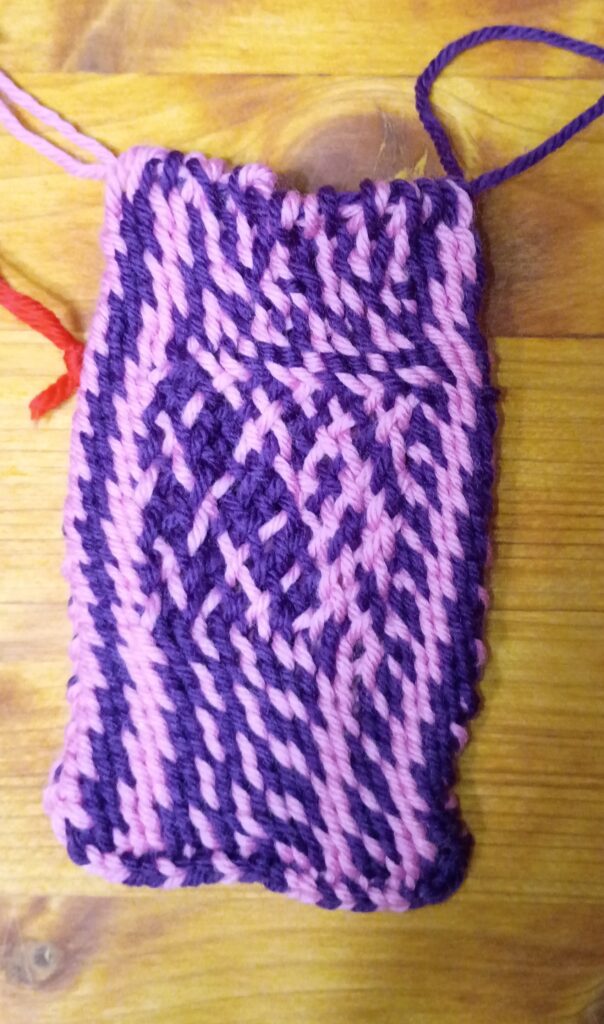
Which led to the next design, where the interlacing was arranged with repeated AAABBB; so that one colour had two adjacent threads on the front, and the other on the back. And the interlacing panel looked nothing like what I’d expected. It was at this point that I finally (belatedly?) realized that the threads that started on the back would slide to the left, an the ones starting on front would slide to the right, so that AAABBB did not produce thinner diagonals, but instead unbalanced diagonals. Back to the drawing board.
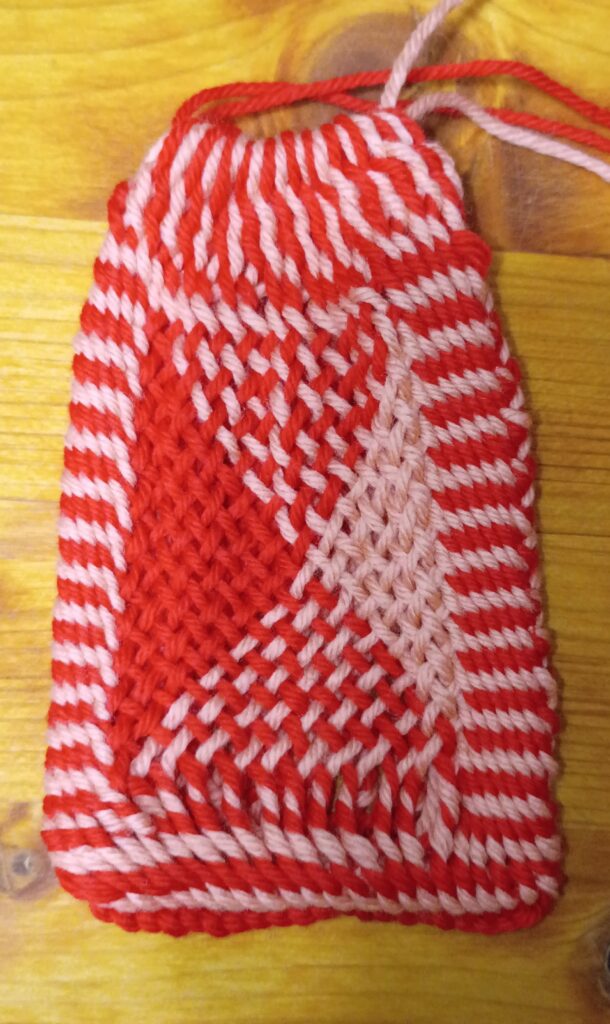
For a complete change in setup, when warping the loops were still alternating colour, but after the first two rows to set the sprang, extra twists were added so that all the front threads were one colour, and the back threads the other colour. This finally created the look I was trying for, inspired by Collingwood. I also beat the individual rows a lot harder, switching from a safety string to 4 skewers; two high and two low, left inserted in the previous two rows. After every row, the oldest skewer was extracted, then placed in the new shed, and a lot of pressure was applied because interlacing is naturally much looser than interlinking.
Everything went swimmingly until I switched back to interlinking, where I accidentally repeated one row instead of switching between braid and overplait. A mistake I didn’t catch until I’d sewn the pouch together. Oops.
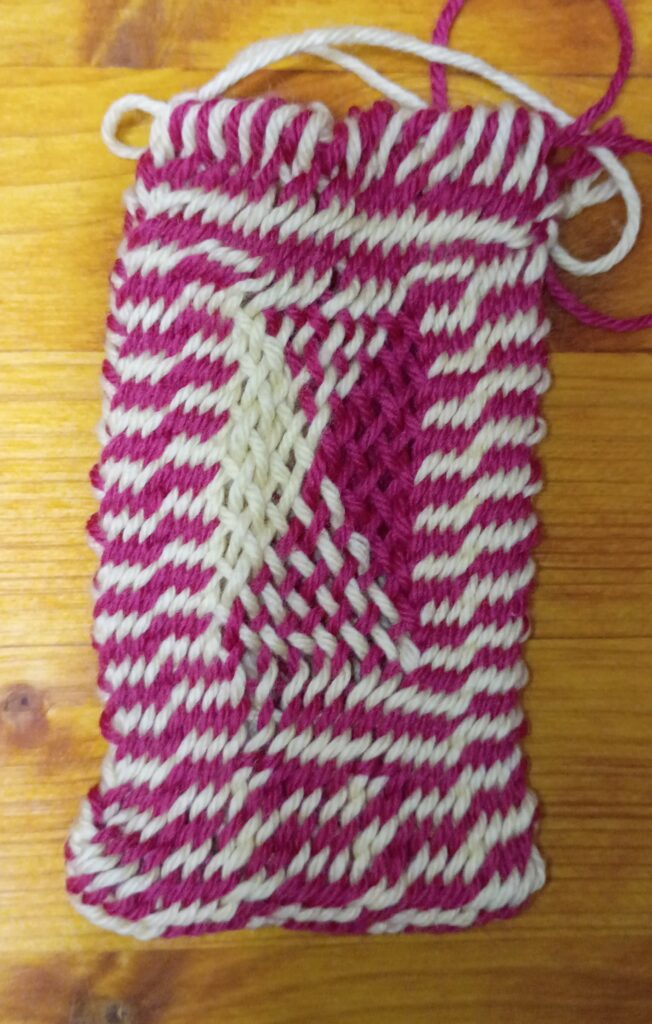
For the last pouch, I changed the width of the interlaced panel so that it was only 8 loops wide, instead of 12, which also meant the interlaced pattern didn’t run as many rows, leaving me with some extra space to place with colour changes near the bottom of the pouch.
The nice thing about churning out a set of five small pouches with variations is that it makes it easier both to understand what I’m doing, and to modify and improve, without necessarily undoing and starting over many times. And now we go on experimenting with other patterns, more colour combos, etc.