How to design patterns

I tend to spend a lot of time fiddling out new patterns, most often for tablet weaving, but also for brickstitch and occasionally blackwork.  In fact, I’ve got blackwork on the brain at the moment after Kim Salazar posted Blackwork Inspiration, an article in which she talks about places to find inspiration.

I realized as I was reading her article that I like designing patterns in tightly constrained spaces.  In tabletweaving, especially when designing patterns designed to be warped up quickly using speed warping, the design is primarily affected by how the tablets turn.  You have essentially three options here; a tablet can turn forwards, backwards, or it can stay idle.  I haven’t really started experimenting with tablet idling yet, so that reduces it to two turns, which can easily be plenty.
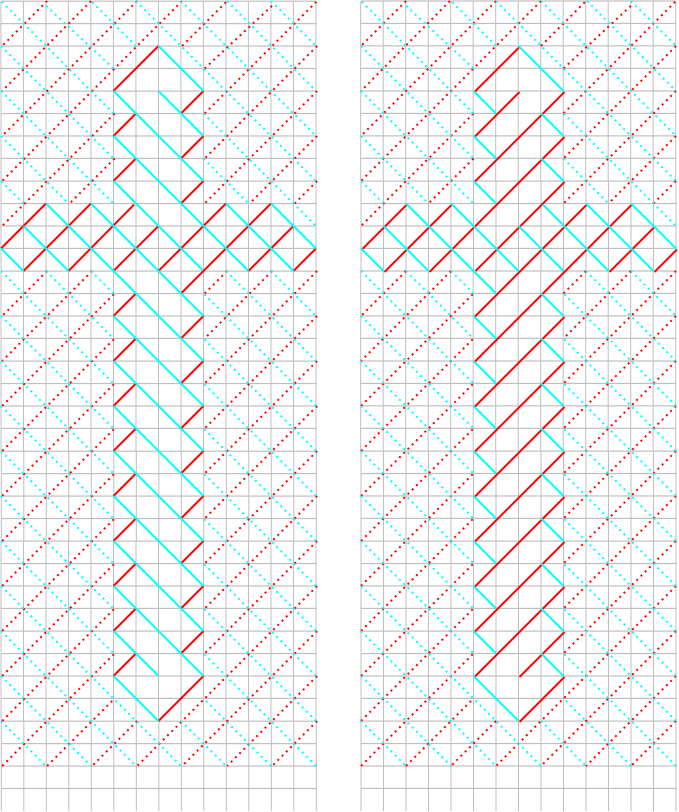
Daggers_14_01Consider for instance an early pattern I called Daggers.  Back when I was graphing this I was using shorthand; each square represents two tablets and two quarter turns.  The colour of the thread is actually indicated by whether the line is solid (colour 1) or dashed (colour 2), and the background colour (colour 3) isn’t shown at all; forward turns are blue and backwards turns are red.

The tablets are warped so that each tablet has, in clockwise direction, colours 1 – 3 – 2 – 3 (although often when I wove it, the background colour and the second colour where the same colour, making the warping 1 – 2 – 2 – 2).  This allows for quick speed warping using the continuous warp method Linda Hendrickson describes in her description of a Continuous Warp (Linda Hendrickson).  After the tablets are all warped, they are set up so that all the cards are threaded in the same direction, and then turned so that colour 1 is – moving from left to right – in the top front hole, top back, bottom back, bottom front, and repeat.  Turning all the cards forward should result in straight diagonals moving to the left.  If the diagonals are jagged, either flip all the cards vertically and reset, or turn every second card two quarter turns.  This is all very similar to setting up for Egyptian Diagonals, except that the tablets are not all threaded two dark, two light.

Dagger on a pink beltIn this version, which is a slightly different pattern where the handle is longer and the guards are much bigger and the background is made with solid coloured diamonds, I was weaving a pink belt; hence the background colour is pink, colour 1 is purple, and colour 2 is white.  And I just noticed I’d left out the dashed lines inside the daggers, so will leave those as an exercise for the reader.

Patterns like this are easy to develop on grid paper; the basic rule for me is to draw out colour 1 first with the following constraints: if the diagonal changes direction, there can be no gap and for the two cards we must go from one diagonal straight to the other.  If the diagonal does not change direction, then there must be a (temporarily) blank square between them.  I can test the design by adding the dotted lines using the same rule.  If there are two parallel diagonal lines there must be a dotted line between them.  And the backgrounds I usually use either the dotted diamonds, or solid diamonds that are properly offset from the main pattern (so that there is room for the dashed lines in between).

Over time I’ve started developing diagrams that use the background (white or gray) to indicate the direction of the turn, and show every thread rather than just the dominant colours, but I find that when I’m just doodling patterns this method suits me just fine.

Embroidery Links

It’s been a quiet house, since Casa Dixie Weaver is embroiled in the new Civ game.  So this week’s update is more of a links fest than anything else.


    • Medieval Silkwork posted a really nice article, back in July, about tassels and Turk’s head knots.  She includes some lovely pictures from extant medieval tassels, and prvious articles include both how to make Turk’s Head Knots and the gimp thread she uses.
    • At Gina – B Silkworks, there’s a new system to make focal beads by rolling up paper and glueing it.  (After which the focal beads can of course be painted, or decorated, at will.)  Gina is the author of “Tak v Bowes”, which is a translation of a manuscript on fingerloop braiding … A manuscript which is sadly out of print.  Poking around the website is fun, as she makes the most gorgeous wrapped buttons.  Sometimes I think her form of wrapped buttons is just another kind of weaving.
    • Opus Anglicanum has started a new stitchalong project; kits come with everything you need, but if you already have the embroidery supplies, all you have to do is download and print the pdfs.  Like last year’s project, she begins with a very good tutorial on the basic covering stitch, including pictures of what the back of the embroidery should look like.

Projects and Folklore and Links

I was reminded last night that the correct order of operations is embroidery first, coffee doctored with Bailey’s second.  Especially when you’re sticking with one colour of thread at a time, so have to carefully count and embroider the next bit and place it on the right spot on the fabric.  In brickstitch, an “off by four” error is … well, the short version is that I will be pulling a Penelope and undoing all the stitches I set last night before I can continue.  So the planned picture of the project’s progress will get delayed.

On the other hand, I have fallen into old rabbit holes again.  Someone recently asked who my hero was, and the sad thing is that my hero – or rather heroine – is the nameless protagonist of the Ballad of Heer Halewijn (wikipedia); Heer Halewijn himself is a malevolent character who likes to kill maidens, because hey, whatcha gonna do when you’re bored, right?  The heroine – usually unnamed but sometimes called Magteld – is a princess who gets permission from her brother to deal with him (after everyone else in the family has said no, leading to a common trope of “Keep asking, kid, until someone says yes”).  She meets him, flirting happens, he offers to let her choose her own death, she chooses beheading … and then steals his sword and chops his head off while he’s distracted.  Ironically of the 40 or so couplets of the ballad, his death is one couplet – two lines – only.  Then she washes his head, takes him home, and presents him to her parents.  For those of you familiar with the Vorkosigan saga, Cordelia’s triumphant return with the Pretender’s head (but not associated body parts) is eerily reminiscent.

I mean, as a young girl growing up, how can you not aspire to be this kind of princess?  Being rescued is … nice, but doing your own rescuing?  Much faster.


Searching out that information reminded me of the Dutch Song Database, which is a treasure trove of old songs, including a project on Souterliedekens (with audio).  To quote the description:

Souterliedekens are rhymed psalm translations in Dutch, set to popular tunes. They were made by the Utrecht nobleman Willem van Zuylen van Nyevelt, who is also responsible for choosing the more than 150 melodies. In this way he hoped to get the youth to sing psalm texts. The Souterliedekens were published in Antwerp in 1540. It is the first complete Psalter in any European vernacular. Nowadays we are most interested in the music: thanks to the melodies of the Souterliedekens, represented in mensural notation, we can sing many of the original secular texts. These texts are only known from sources without music, such as the Antwerp Songbook (1544). By combining the texts from the Antwerp Songbook with the melodies of the Souterliedekens we can reconstruct the popular music of the sixteenth century.
You can listen to the first stanza of all the Souterliedekens, sung by a choice of Dutch and Flemish singers, recorded in 2001 for the Repertorium of Dutch Songs until 1600.

I am happily rooting around in that database in my spare time.

Playing with Brickstitch

Brickstitch is quite addictive in a lot of ways; it’s very geometric and the final product often looks as though the fabric was woven rather than embroidered, especially from a distance.

I hypothesize that this is due to the embroidery stitches all being parallel.

In any case, I like to work patterns out in a software program called inkscape which is a free vector based drawing program available in windows, mac os, and linux (and I use it under linux).

Celtic Knots in BrickstitchSo I was doodling, and created the following pattern.  In dark colours you can’t see the implied knotwork (in black the boundaries are just plain invisible, sadly) but in lighter colours the knotwork should be subtle but visible.  Since I will be embroidering an entire pouch in gold, green, and blue for the hubby, we will test that theory most assiduously.

Except that hubby wants the following colour changes:

  • blue and green become medium blue
  • tan becomes green (but I’m going to use two tones of green since each figure 8 is actually two intertwined ribbons)
  • yellow becomes gold.

Kingdom Arts & sciences Championship 2015 – The Final Post

Having returned home from the championship, I had a blast.  I enjoyed entering, I enjoyed judging other entries, I enjoyed geeking out with fellow artisans …

And since I am human, I enjoyed winning.

But my very favourite comment was from a lady who had judged my research paper, and who had enjoyed the paper so much she asked for permission to share it with her daughter.  Mission to make a paper about math accessible to non-mathies accomplished!

Documentation Uploaded

So the documentation is as complete as it is going to be, and is uploaded to the Projects Page.  Next step is packing up, and getting ready to move on out.

This is a bittersweet championship.  I just don’t see the point in entering any more.  What did me in was having to change my documentation up when the new category criteria and guidelines were posted on Tuesday, for the competition on Saturday.

Kingdom Arts & Sciences Championship, 2015

Next Saturday, 19 Sept 2015, Gleann Abhann will host its tenth annual Kingdom Arts & Sciences Championship (and will be celebrating 10 years as a Kingdom, to boot), and I have been working feverishly to get all the entries together.


As of last night I have finished (not counting documentation):

  1. The research paper on mathematical textbooks and bookkeeping
  2. Tabletwoven seal tags based on seal tags circa 1200
  3. An alms pouch, embroidered with an original design based on my personal heraldry

In progress is a meditation journal; I’ve taught the drawing of Celtic Knots before, and started creating a journal of knots and their skeleton structures so that students can see some possible knots and can use the skeleton structures to recreate those same knots.


Dixie Weaver will also be at the event, ready to sell silk, books, and other sundries.